
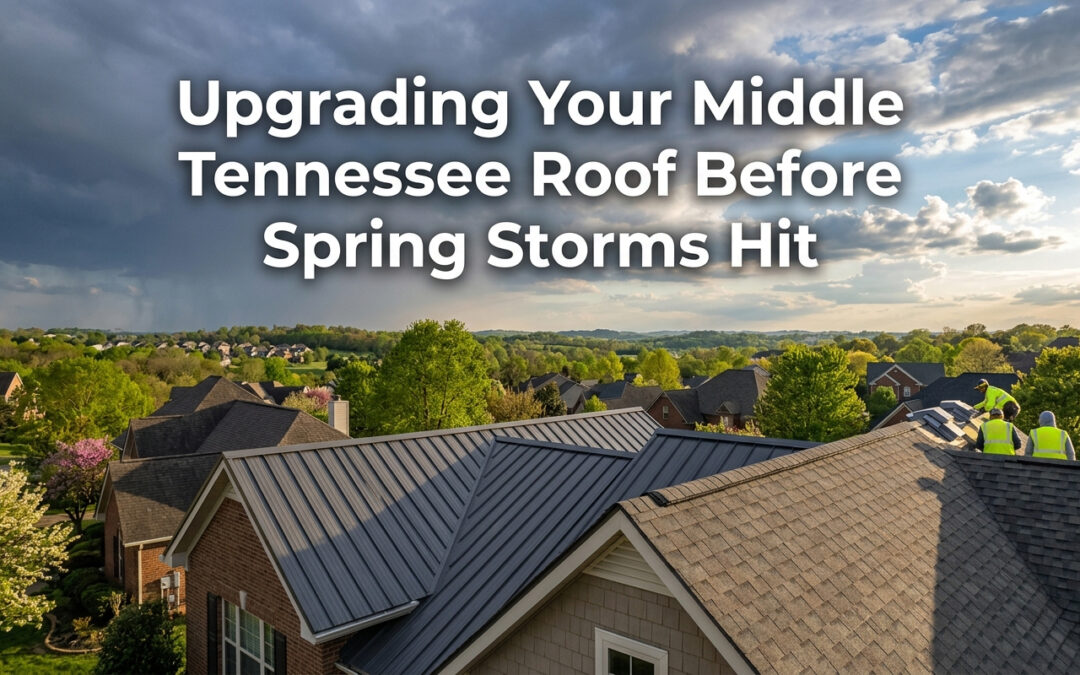
As we all know, there is nothing quite like a peaceful spring evening in our neck of the woods. But we also know that those calm nights can turn into severe weather in the blink of an eye. With spring upon us, we are officially heading into the peak season for thunderstorms, high winds, and hail.
At Shrum’s Roofing Company, we aren’t just a business serving Gallatin, Hendersonville, and the greater Nashville area: we are your neighbors. We’ve lived through the same storms you have, and our families sleep under the same Tennessee sky.
We’ve spent decades repairing the damage that unpredictable spring weather can do. Through all that experience, we’ve learned one crucial thing: The best defense is a proactive offense. Waiting until you have a leak to worry about your roof during storm season is like waiting until it’s pouring to buy an umbrella.
This spring, we want to help you shift your mindset from repair to resilience. If you are already considering replacing your roof, or if you simply want the peace of mind that comes with knowing your home is secure, here’s a quick guide to some storm-resistant roof upgrades designed specifically for Middle Tennessee homes.
Understanding Our Enemy: The Tennessee “Triple Threat”
A “standard” roof might survive a normal rainstorm, but Tennessee springs aren’t standard. A storm-resistant upgrade addresses the three major ways our local weather tries to destroy a roof:
- High Winds: Spring systems often bring straight-line winds or tornadic activity. Wind doesn’t just peel shingles off; it can create “uplift” that tries to tear the entire roof deck away from the house structure.
- Hail: Our region is increasingly prone to hail. Even pea-sized hail can bruise shingles, leading to granule loss and cracking, while golf ball-sized hail can fracture a shingle instantly, exposing the wood decking below.
- Water Intrusion: It’s not just how much it rains, it’s how it rains. Wind-driven rain can push horizontally, finding any gap in your flashing or blowing underneath standard shingles.
Upgrade #1:
The Seal of Protection: A Sealed Roof Deck
If you are replacing your roof, this is the single most important upgrade we can recommend.
- How it works: Traditionally, underlayment (felt paper) is tacked onto the plywood deck before shingles go on. If the shingles blow off, the felt paper is easily torn away, leaving your plywood exposed to rain. A sealed roof deck uses specialized, self-adhering membranes (such as ice and water shield) that adhere directly to the plywood and seal around every nail.
- The Storm Benefit: It creates a secondary, continuous watertight barrier. Even if a strong gust of wind peels away a section of your shingles, your home remains dry. The water hits the membrane and runs off, saving your attic, insulation, and ceilings from catastrophic damage.
Upgrade #2:
Stand Tall Against Wind: High-Wind Rated Shingles
Many older or lower-quality shingles are only rated for 60-90 mph winds. Modern storm-resistant shingles offer a significantly higher line of defense.
- How it works: We recommend upgrading to high-performance, architectural, or dimensional shingles. These aren’t just thicker; they are engineered with wider, stronger fastening zones (often called “nail lines”) and enhanced adhesive strips. We frequently install GAF Timberline HDZ shingles because they are high-quality and form a watertight, wind-resistant seal when properly installed by a certified team like ours.
- The Storm Benefit: Many of these shingles carry wind warranties up to 130 mph. That is the difference between your roof holding strong during a severe thunderstorm and you having to call your insurance company the next morning.
Upgrade #3:
The Ultimate Guard Against Hail: Class 4 Impact-Resistant Shingles
If hail is your biggest worry, you need a shingle with a fight in it. Shingles are tested for impact by dropping steel balls from specific heights and rated on a scale of 1 to 4.
- How it works: A Class 4 rating is the highest standard for impact resistance. These shingles are often made with a polymer-modified asphalt (essentially, rubberized asphalt), which makes them flexible rather than rigid. When a hailstone hits, the shingle absorbs and deflects the energy instead of fracturing or losing its protective granules.
- The Storm Benefit: They drastically reduce the risk of hail punctures, fracturing, and long-term granule loss. Furthermore, many insurance carriers offer substantial discounts on annual premiums for homes with a verifiable Class 4 roof.
Upgrade #4:
The Middle Tennessee Legend: Standing Seam Metal Roofing
Finally, we have to talk about the premium upgrade. In terms of sheer toughness, longevity, and storm resistance, a standing seam metal roof is the gold standard.
- How it works: “Standing seam” means the metal panels interlock with vertical legs, and all the fasteners are hidden beneath the surface. At Shrum’s, we have our own metal panel machine in our office. We don’t buy pre-made panels; we custom-fabricate your standing seam panels right here in Gallatin from thicker, 24- or 26-gauge metal, ensuring a perfect fit with no exposed holes where moisture could seep through.
- The Storm Benefit: Metal is inherently fire-resistant, sheds water instantly, and laughs at hail that would shatter asphalt. Most importantly, a properly installed standing seam system has incredible wind uplift resistance, with some systems rated to withstand winds over 180 mph. It’s not just a roof; it’s armor.
We’re Your Neighbors. We’re Here to Help.
Upgrading your roof is a significant decision. You don’t have to navigate it alone. Our team at Shrum’s Roofing is here to advise you on what makes sense for your home, your neighborhood, and your budget.
Whether you need a full replacement with these upgrades or just want a detailed, honest spring inspection to ensure your current roof is ready for whatever March and April have in store, we are ready to serve you.
Don’t wait for the storm to tell you your roof is weak. Call Shrum’s Roofing today at (615) 675-4489, or fill out our online form to schedule your free spring inspection.